
AML/CTF Reforms — Protecting More Than Just Compliance
From 1 July 2026, accountants and other gatekeeper professions will formally fall within Australia’s AML/CTF regime. These reforms are about protecting more than just compliance.
AML/CTF Reforms — Protecting More Than Just Compliance
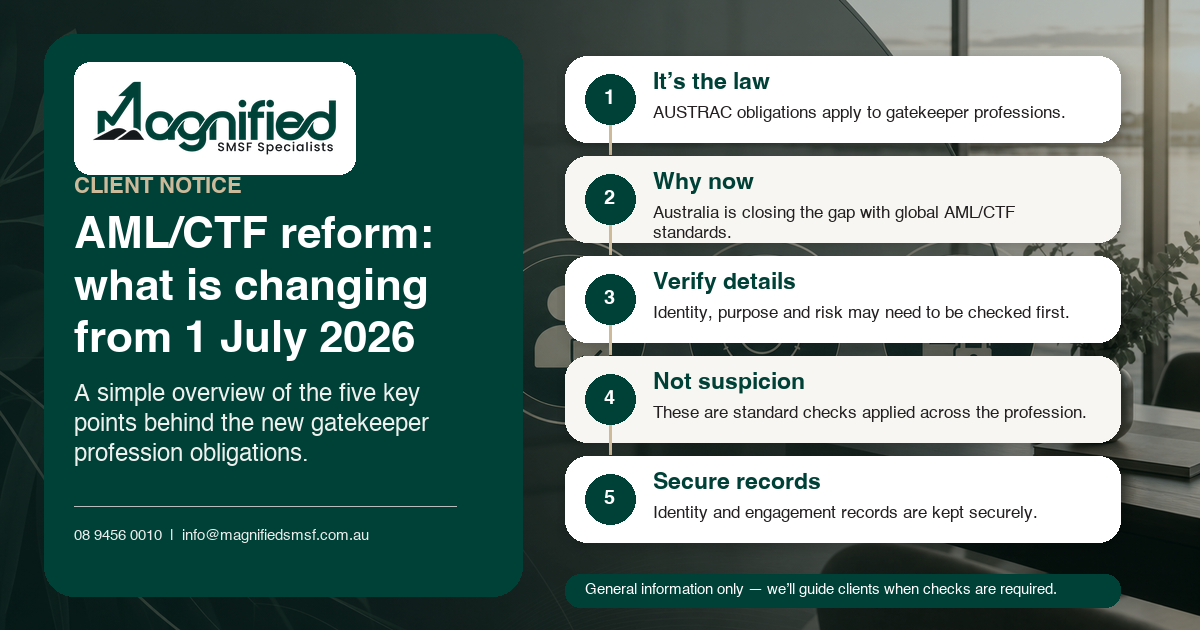
From 1 July 2026, Australian accountants, lawyers, trust and company service providers and other “gatekeeper professions” will formally fall within Australia’s Anti-Money Laundering and Counter-Terrorism Financing (AML/CTF) regime.
For many clients, the first reaction to these changes may be frustration:
“Why do I suddenly need to provide identification again?”
“Why are accountants asking these questions now?”
“Why is there more paperwork?”
These are fair questions — but there is also a much bigger story behind these reforms.
The reality is that AML/CTF laws are not simply about administration or bureaucracy. They exist because financial systems around the world are regularly exploited to fund some of the most harmful criminal activities imaginable — including human trafficking, child exploitation, narcotics trade, organised crime, cybercrime and terrorism.
The Hidden Economy Behind Financial Crime
Illegal financial activity is not small-scale. Globally, money laundering is estimated to involve trillions of dollars every year, making it one of the largest underground economies in the world.
Criminal organisations rely on legitimate financial systems to:
- move money,
- disguise ownership,
- purchase assets,
- establish companies and trusts,
- transfer wealth internationally, and
- create an appearance of legitimacy.
Professionals such as accountants, lawyers and advisers are often targeted because of the role we play in establishing and administering financial structures.
Most clients would never knowingly assist criminal activity — however, criminals depend on gaps in the system where identity verification and source-of-funds checks are weak or inconsistent.
That is exactly what these reforms are designed to address.
Why Australia is Introducing These Changes
Australia has historically lagged behind many other developed countries in applying AML/CTF obligations to professional service providers.
The reforms commencing from 1 July 2026 are intended to align Australia with international standards set by the Financial Action Task Force (FATF), which promotes global cooperation in combating financial crime.
Banks have operated under these rules for many years. The new reforms simply extend similar obligations to professions involved in financial structuring, transactions and advisory services.
This means that firms like Magnified SMSF Specialists will now be legally required to undertake certain identification and risk assessment procedures before providing designated services.
What This Means for Clients
In practice, clients may be asked to provide:
- identification documents,
- verification of entities or beneficial owners,
- information about the purpose of a transaction or structure,
- details regarding source of funds or wealth, and
- updated records where information has changed.
Importantly, these checks are not based on suspicion.
They are a blanket legal requirement that applies across the profession. Every client is treated consistently, regardless of the size of their fund, business or investment portfolio.
For SMSFs specifically, these obligations may arise in situations such as:
- establishing an SMSF,
- setting up a corporate trustee,
- implementing certain investment structures,
- property acquisitions,
- borrowing arrangements, or
- other designated advisory services.
If required checks are not completed, legislation may prohibit the adviser from proceeding with the engagement.
A Shared Role in Protecting the Financial System
While the additional compliance requirements may initially feel inconvenient, there is also a positive side to these reforms.
Every proper identity check, every verification process and every risk assessment helps make Australia’s financial system harder for criminals to exploit.
In a very real sense, these reforms are about:
- reducing the flow of money linked to human exploitation,
- disrupting organised crime networks,
- limiting terrorism financing,
- combating large-scale fraud and cybercrime, and
- protecting the integrity of legitimate businesses and investors.
Most people would agree that if a small amount of additional verification helps reduce the funding of these activities, it is a worthwhile outcome.
Our Commitment
At Magnified SMSF Specialists, we understand that these changes may feel unfamiliar at first. Our goal is to make the process as smooth and practical as possible while meeting our legal obligations.
Where possible, we will streamline requests using information already held on file and guide clients through any additional requirements clearly and efficiently.
These reforms are not about creating unnecessary barriers. They are about strengthening trust, protecting the integrity of the financial system and helping prevent legitimate structures from being misused for harmful purposes.
And ultimately, that is something worth supporting.